Supplier & Material Risk
Combine supplier master data, material/lot context, quality history, documents, external signals, deterministic checks, AI-assisted review, approval and evidence.
Manufacturing & Supply Chain
Connect supplier records, production and quality data, documents, operational events, AI assistance, deterministic rules, human decisions, and downstream actions in purpose-built applications — while keeping existing ERP, MES, QMS, WMS, historians, and control systems authoritative for the responsibilities they already own.
Explore manufacturing architectureIllustrative application scenario
A deviation or nonconformance case can bring the production context around a quality event together without turning the AI model into the system of record.
Combine supplier master data, material/lot context, quality history, documents, external signals, deterministic checks, AI-assisted review, approval and evidence.
Create a durable case around deviations, measurements, specifications, root-cause evidence, disposition, CAPA-like follow-up where applicable, and historical reconstruction.
Turn alarms/events/production exceptions into a case/work queue with current operating state, permitted context, human ownership, next action and evidence.
Use sensor/feature/anomaly signals as evidence for investigation and routing while keeping maintenance systems and physical-control systems authoritative.
Coordinate inventory, shipment, carrier, warehouse and customer commitments around delays, shortages, holds or rerouting decisions.
Use identity, legal-entity scope, verification, approval, durable state, external writeback and Effect Receipts around high-risk supplier changes.
Combine permission-aware knowledge, operating procedures, equipment context and role-specific applications for troubleshooting and governed action.
| Information type | Meaning |
|---|---|
| Operational State | What ERP/MES/QMS/WMS/connected authoritative systems currently say is true. |
| Time-Series / Event Observation | A measured or reported event tied to source/time and quality. |
| Decision Feature | Calculated or derived proposition used by rule, model, policy, or reviewer. |
| Retrieved Evidence | Relevant documents/procedures/history selected for this case. |
| AI Proposal | Classification, summary, suspected cause, routing suggestion, draft action. |
| Human Decision | Authorized disposition or judgment. |
| External Effect | Resulting state change in the authoritative downstream system. |
Use models for interpretation, extraction, classification, anomaly explanation, evidence selection, summarization, and ambiguous correspondence where probabilistic reasoning adds value.
Manufacturing and supply-chain cases can wait on lab results, supplier responses, engineering review, maintenance windows, parts, inspections, transport events, or management approval. Durable execution should preserve the case while relevant authority, operating state, policy, and data are revalidated before consequential action.
Frozion is designed to participate in applications that observe operational data and issue governed commands through supported integration boundaries. Existing industrial control systems remain responsible for physical control; this is not a replacement for SCADA, a safety PLC, DCS, or a real-time control system.
Where physical actions are possible, keep the boundary explicit: Application Proposal → Policy / Human / Safety Conditions → Eligible Integration → External Control System → Effect / Confirmation.
A plant application may combine private/on-prem processing for sensitive or low-latency data, regional services for approved workloads, and public/provider-hosted models for eligible information. Route eligibility should be a workload property, not a blanket “all factory AI is on-prem” rule.
Illustrative workflow
| Platform area | Manufacturing / supply-chain role |
|---|---|
| App Builder | Operations cases, work queues, quality review, supplier portals, dashboards, evidence views |
| AI Data Plane | Operational data, documents, time-aware context, features, knowledge, provenance/evidence |
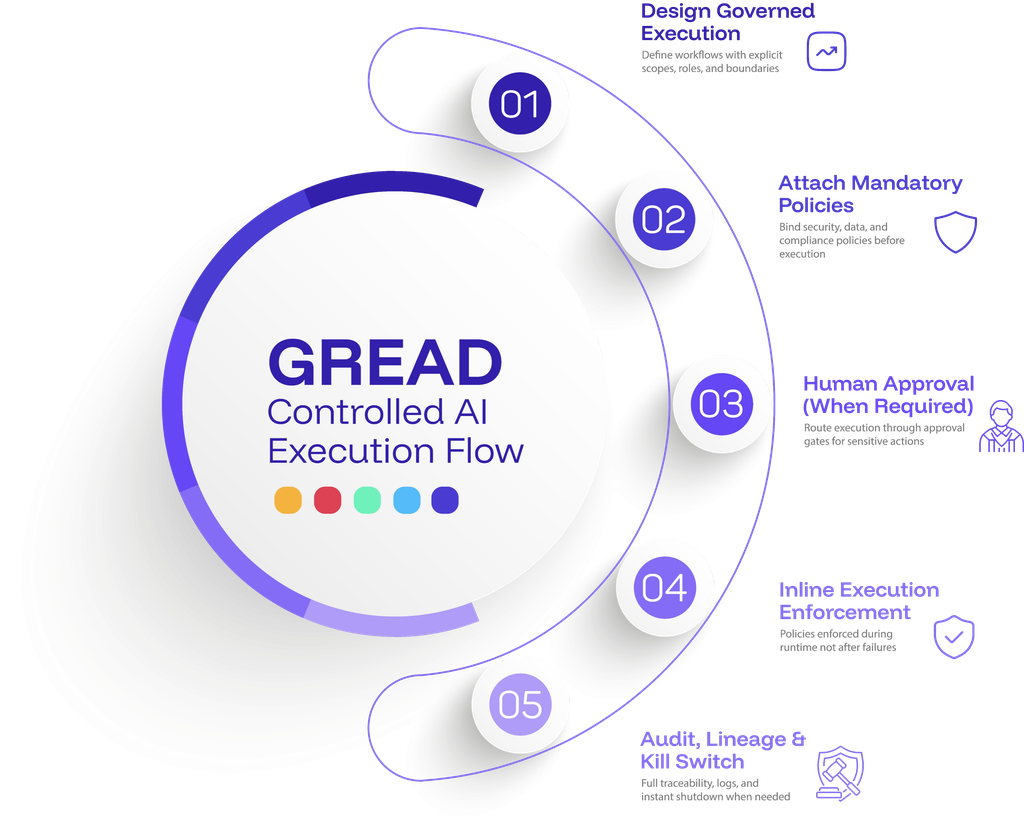
| AI Control Plane | Execution, deterministic checks, AI routing, policy, durable waits, human review, external actions |
| Identity & Security | Plant/site/legal-entity/resource/purpose/classification scope |
| Private & Hybrid AI | Workload-specific plant / private / regional / hosted eligibility |
| Extensibility | ERP/MES/QMS/WMS/CMMS/SCADA-adjacent APIs, event streams, models and custom capabilities |
No. Those systems can remain authoritative. Frozion provides the governed application layer around cross-system AI-assisted work.
The architecture can consume operational observations through supported integrations and can use features or anomaly outputs inside governed applications. Exact protocols, rates, and connectors must be verified.
Frozion is not presented as a certified safety control system. Safety-critical control remains in the appropriately engineered and certified industrial control system.
The architecture supports private/hybrid patterns subject to the exact supported topology and integrations.
Any physical or consequential action must be governed by the customer-approved process, safety architecture, policy, authority and implementation. Autonomous plant control is not assumed.